From Search Data to Profitable Campaigns: How Affiliates Use Intent to Improve Campaigns
Affiliate traffic is not search traffic. Pop, zero-click, and video formats don’t behave like Google Ads — and trying to force them into that logic usually leads to frustration.
When someone sees your ad in a performance format, they’re not actively searching for a solution. They’re browsing, reading, watching, or scrolling. Your message appears as an interruption. That changes the dynamics of persuasion.
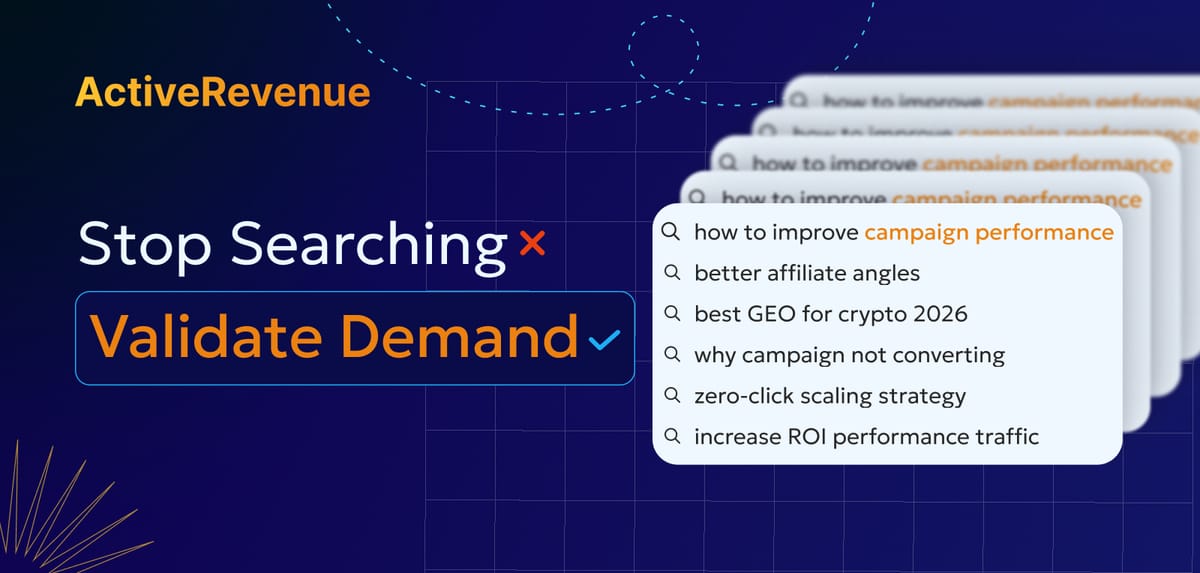
But here’s the part many affiliates overlook: even if your traffic source isn’t search-based, your audience still uses search engines every day. And that behavior leaves signals.
Those signals are valuable.
You can’t bid on them directly in pop or zero-click campaigns. But you can use them to shape how your campaign speaks.
That’s the difference between guessing angles and building them on real demand.
Search Behavior as a Demand Indicator
Search queries reflect active curiosity. When people type something into a search engine, they’re revealing intent — sometimes weak, sometimes strong, but always deliberate.
If thousands of users suddenly begin searching for:
▪️ “AI trading app legit”
▪️ “best crypto bot 2026”
▪️ “how to lose weight before summer”
▪️ “loan without credit check”
That’s not random noise. That’s emerging or intensifying demand.
Before launching a campaign, looking at search trend direction answers a critical question:
Is this topic heating up, cooling down, or staying flat?
If it’s clearly declining across major GEOs, scaling will be harder and more expensive. If it’s climbing — especially in specific countries — you’re potentially entering at the right time.
Performance traffic works best when it amplifies existing attention rather than trying to create it from nothing.
From Queries to Positioning
Search data is not useful because of keywords. It’s useful because of context.
Take crypto as an example. When search patterns shift from “how to buy bitcoin” to “is AI trading legit,” the mindset has changed. The audience is no longer just curious — they’re evaluating, comparing, and questioning.
A creative that ignores that shift will feel disconnected.
A creative that acknowledges skepticism — even subtly — feels more aligned.
The same applies in nutra. Weight loss search trends rarely revolve around generic phrases alone. They often cluster around pain points: stubborn belly fat, slow metabolism, short timelines before events. That tells you what people are actually worried about.
Instead of broad claims about “fast results,” you can position around urgency, visible progress, or specific frustrations — because that’s what search behavior reveals.
In finance, search intent frequently exposes emotional pressure. Queries about rejection, approval speed, or credit checks signal anxiety. When campaign messaging reflects those concerns, it feels less like an interruption and more like a potential solution.
You’re not targeting keywords. You’re responding to psychological signals.
GEO Patterns: Where Attention Is Moving
Search interest rarely rises evenly across markets.
Sometimes a topic gains momentum in Tier 1 English-speaking GEOs first. Other times, emerging markets show earlier spikes due to local trends, regulation shifts, or media coverage.
Looking at regional search interest before allocating budget adds a layer of intelligence to campaign planning.
If a vertical is trending upward in Italy and Canada but flattening in Germany, that doesn’t mean Germany won’t convert. It means your scaling priorities might change.
Performance formats offer reach. But intelligent scaling starts with understanding where attention is increasing.
Seasonality and Early Entry
Many verticals follow predictable cycles, but the beginning of those cycles often appears first in search data.
Weight loss demand begins rising weeks before summer. Travel-related interest increases before peak holiday seasons. Crypto curiosity accelerates before visible price surges become mainstream headlines.
If you wait until peak hype, competition is already high. Bids rise. Creative fatigue spreads faster.
Entering during the early growth phase — when search momentum is building but saturation hasn’t peaked — often creates better efficiency.
Search trends can reveal that early movement.
Why This Matters in Performance Traffic
Performance formats are often described as “volume traffic.” That definition isn’t wrong — but it’s incomplete.
Volume alone doesn’t create profit. Relevance does.
Whether you’re running pop, zero-click, video, or other scalable formats, your success depends on how closely your message matches the user’s current mindset. When creatives align with topics users have recently researched, compared, or questioned, the interruption feels less random. It feels connected.
That familiarity increases the likelihood of engagement. Not because the format changed — but because the positioning improved. You’re not intercepting search traffic. You’re acknowledging that your audience already searched — and carrying that context into a different environment.
That’s the shift. And in performance marketing, small strategic shifts often create outsized results.
A Smarter Workflow Before Launch
In practical terms, integrating search insight into performance campaigns doesn’t require complex tools. It requires a small adjustment in preparation.
Before launching:
▪️ Check whether interest in the offer’s core topic is rising or falling.
▪️ Look at related queries to identify dominant concerns or motivations.
▪️ Observe which GEOs show momentum.
▪️ Consider seasonal timing.
It doesn’t take hours. But it changes how you build creatives and choose markets.
Affiliate marketing will always involve testing. There is no way around that. But testing guided by behavioral signals is fundamentally different from testing built purely on assumption.
Search engines reveal what people care about right now.
Performance formats allow you to scale that attention.
Used together, they create leverage that neither channel could provide alone.
And that’s where smarter campaigns begin.