How to Choose GEO When “Best GEOs” Stop Working
When popular GEOs stop converting, chasing new “best GEO” lists rarely helps. This article explains how to choose GEOs using logic, performance signals, and real industry patterns.
If you search for “best GEOs for affiliate marketing,” you’ll see the same thing again and again: lists of countries that supposedly work right now. Sometimes they do. Sometimes they don’t. And very often, they stop working faster than expected.
This is not because the lists are “wrong.” It’s because GEO performance is not a fixed truth. It’s a moving system influenced by competition, user behavior, traffic quality, creatives, and timing.
In this article, we’ll talk about how to choose GEOs when popular GEOs stop delivering, using public industry patterns, logic, and a real-life scenario many affiliates face.
Why “Best GEO” Lists Age So Fast
Most industry blogs publish GEO lists based on current demand and advertiser activity. These lists are useful — but only as a snapshot.
The problem starts when affiliates treat them as a long-term strategy.
What usually happens:
▪️ A GEO becomes popular
▪️ More advertisers enter the auction
▪️ Traffic cost goes up
▪️ User attention goes down
▪️ Margins get thinner
So the question is not “Which GEO is best?” The real question is “Why does this GEO work right now — and for how long?”
A Common GEO Performance Scenario
This is a composite scenario based on patterns often discussed in affiliate communities and case studies.
The situation
An affiliate launches a campaign in a popular Tier-2 GEO.
At first, everything looks fine:
▪️ Spend is stable
▪️ CTR looks healthy
▪️ Conversions are coming in
▪️ ROI is positive
Then, without any obvious changes, profit starts to disappear.
To make this pattern clearer, here’s how it often looks over time.
Typical GEO Performance Timeline
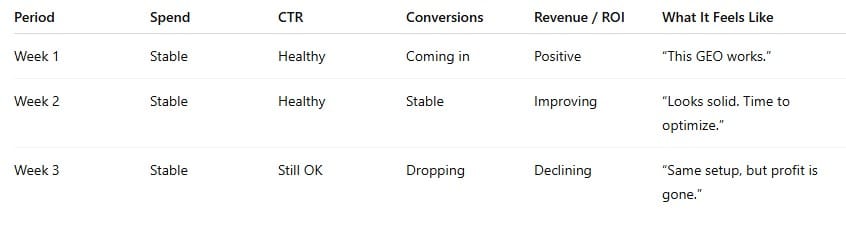
This doesn’t mean the GEO suddenly “died.” In most cases, it means the conditions around the GEO changed, while surface metrics stayed almost the same.
What Usually Causes This Drop
In most cases, the GEO itself is not the real problem. The problem is what changed around it.
The most common reasons are:
Traffic saturation
More buyers entered the same GEO. Auction pressure increased. You are now buying slightly worse traffic at a higher price.
Creative fatigue
Users in that GEO have already seen similar messages multiple times. Even if CTR looks fine, intent is lower.
Funnel mismatch
The funnel worked at first, but once the “easy” users converted, the rest needed a better explanation, trust signals, or localization.
False scaling signals
Early performance looked strong, but it was driven by a small, high-intent segment that cannot scale.
This is why saying “this GEO is dead” is usually the wrong conclusion.
How to Read GEO Performance Without Internal Data
Even when you only see your own campaign data — and not the full market picture — widely observed GEO tier patterns help set realistic expectations.
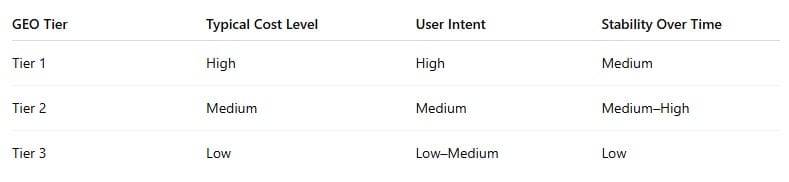
When we say “medium–high stability” we don’t mean stable profits forever. We mean more predictable behavior compared to Tier-3 markets.
Tier-2 GEOs usually react more slowly to auction pressure and saturation, which gives advertisers more time to test, optimize, and adjust. However, once competition increases and creatives or funnels stop evolving, performance can still drop — just not as abruptly.
The Real Question to Ask When Results Drop
Instead of asking “Which GEO should I switch to?”, ask this:
What signal changed — cost, intent, or funnel fit?
If cost went up but behavior stayed the same, the issue is competition.If behavior changed but cost didn’t, the issue is user fatigue or mismatch.If both changed, scaling too fast might be the reason.
This mindset shift is critical. GEO choice is not a one-time decision. It’s a continuous adjustment process.
How to Choose the Next GEO (Without Guessing)
When a popular GEO stops working, many affiliates jump to the next “hot” country. A more stable approach is to change one variable at a time.
For example:
- Keep the same offer, test a similar GEO with slightly different economic conditions
- Keep the same GEO, but adapt the funnel or message
- Keep the same setup, but reduce exposure and refresh creatives
Affiliates who do this lose less during transitions and recover faster.
Why GEO Logic Beats GEO Lists
Lists tell you where people are buying today. Logic helps you understand why they are buying — and when they will stop.
This is especially important if you work with Zero-click traffic, Push or pop formats and offers sensitive to fatigue and timing.
In these cases, GEO performance is tightly connected to user mood, repetition, and trust, not just price.
Final Thoughts
There is no permanent “best GEO.”
There are:
▪️ GEOs that fit your offer right now
▪️ GEOs that give you data cheaply
▪️ GEOs that scale — and then push back
The affiliates who survive long-term are not the ones who just chase lists. They are the ones who read signals, understand patterns, and adjust before the drop becomes painful.
If a GEO worked for two weeks and then stopped, it didn’t fail you. It just told you something changed. The key is learning how to listen.
The more visibility and control you have over your campaigns, the easier it is to spot when performance shifts — and react before profit disappears.
That’s the mindset we build ActiveRevenue around.