Mexico iGaming Affiliate Traffic: Mobile-First Funnels, Local Payments, and Creative Details That Matter
A practical Mexico iGaming traffic guide for affiliate media buyers: mobile-first funnels, local payments, creative localization, and GEO segmentation.
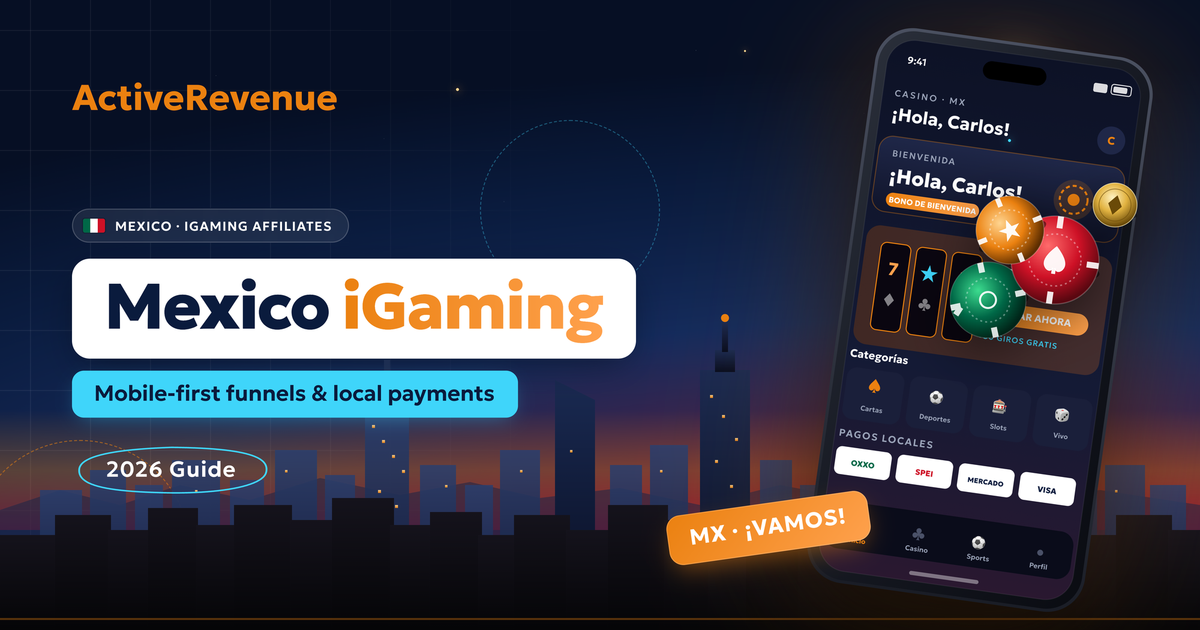
Mexico looks easy from the outside.
Big football culture. Strong mobile usage. Lower media costs than the usual Tier 1 GEOs. Plenty of users who already understand betting, casino apps, and entertainment offers.
But that is exactly why a lot of affiliate campaigns get read wrong.
They treat Mexico like "Spanish-speaking LATAM traffic" and push the same lander, same bonus angle, same payment language, and same city mix into one campaign. The traffic might look cheap at the click level. The funnel usually tells a different story later.
This guide is for affiliates and media buyers buying CPC and CPM traffic into iGaming offers. We are not going to talk about Mexico as a generic expansion market. We are going to treat it like a campaign setup problem: mobile behavior, local trust signals, payment comfort, creative localization, and GEO segmentation.
Why Mexico behaves differently from generic LATAM traffic
The first mistake is putting Mexico inside one broad LATAM bucket. That makes reporting easier, but it makes optimization worse.
Mexico has its own sports habits, payment expectations, language patterns, city differences, and creative triggers. A campaign that works in Argentina, Colombia, or Chile does not automatically work in Mexico just because the language is Spanish.
For iGaming, the market has a few things going for it:
- Strong football culture
- High mobile engagement
- Familiarity with entertainment apps
- Lower entry costs compared with oversaturated Tier 1 GEOs
- Enough local identity to make generic creatives feel weak fast
That combination is useful, but only if the funnel respects it.
If your prelander says "LatAm players love this casino," you are already wasting the GEO. If your bonus page shows USD, generic Spanish, and no local payment cues, you are asking the user to trust a funnel that does not feel built for them.
The better question is simple: would this page feel like it was made for a Mexican user, or just translated for one?
Mobile-first is not optional in Mexico
Mexico iGaming traffic should be planned mobile-first from the start.
More than 75% of Mexican users access content through mobile, and users are already comfortable downloading apps for entertainment. That changes how you should build the campaign.
A desktop-style casino comparison page with heavy blocks, long tables, and slow scripts might look useful to you. On mobile, it creates delay, friction, and unreadable data.
The practical requirements are not complicated:
- Keep the first screen simple
- Show the offer, bonus, payment cue, and next step quickly
- Use vertical assets, app-style screenshots, and short copy blocks
- Avoid heavy widgets, slow scripts, and unnecessary redirect chains
- Keep mobile load time under 2.5 seconds
That last point matters. If the page loads slowly, you do not just lose users. You also lose the ability to read the campaign properly.
A slow lander can make a good traffic source look bad. It can make one city look weak. It can make one creative seem unprofitable. Really, the funnel just made users wait too long.
Before scaling Mexico traffic, test your lander on a real mobile connection. Not just desktop preview. Not just Lighthouse. Open the page like a user would, with tracking links, scripts, redirects, and the actual offer path included.
Local payment trust can decide the click
In iGaming, payment trust is part of the creative.
Users are not only asking, "Do I want this bonus?" They are also asking, "Can I actually deposit and withdraw in a way that feels familiar?"
For Mexico, local payment cues like Banorte, BBVA, SPEI, OXXO, and Mexican Pesos carry real weight. Those details are easy to overlook, but they can change how the funnel feels.
If your page shows the bonus in dollars, uses generic card icons, and hides payment methods until the operator page, you are creating uncertainty before the user even reaches the offer.
Better structure:
- Mention MXN when the offer supports it
- Show familiar payment rails where accurate
- Use local bank/payment references only when the operator really supports them
- Keep deposit and bonus terms visible before the clickout
- Do not imply payment methods that are not available on the final offer
That last point is important. Payment cues help conversion only if they are true. If the prelander says SPEI but the operator page does not support it, the click quality will collapse. You might still get CTR. You will not get clean downstream performance.
This is where affiliates should work backwards from the operator. Before writing the lander, check what the final page actually supports: currency, payment methods, minimum deposit, withdrawal rules, bonus terms, and restricted states or regions. Then build the prelander around those facts.
Creative localization goes beyond Spanish copy
Translation is not localization.
Mexico-specific Spanish matters, but the creative layer needs more than correct grammar. It needs to feel native enough that users do not read it as a generic casino page with swapped language.
Useful creative directions:
- Football references — Liga MX, Champions League, Club América, Chivas, Chucky Lozano
- Mexican visual cues — flags, folkloric patterns, piñatas, cacti, Lucha Libre aesthetics
- Seasonal hooks — Independence Day, Cinco de Mayo, Christmas, Día de los Muertos
- App-style screenshots and vertical video assets
- User-generated content angles that sound realistic, not scripted
The key is not to overload every creative with every cultural symbol. A page with flags, skulls, sombreros, football jerseys, confetti, and five bonus badges usually looks cheap. Pick one angle and make it clean.
For example:
- Football angle: match timing, club references, live betting intent, fast deposit cue
- Casino angle: slots, scratcher visuals, bonus comparison, MXN deposit cue
- UGC angle: short testimonial-style creative built around a small first bet, not a fake luxury-win story
- Seasonal angle: one relevant holiday, one bonus hook, one clear CTA
Also watch for local negatives. Yellow can carry mourning associations in Mexico, and cats may trigger negative reactions for some users. That does not mean you never use those elements. It means you do not blindly port creatives from another GEO and assume they are neutral.
For media buyers, the practical takeaway is simple: local creative is not decoration. It is a targeting and trust layer.
Segment Mexico before the data gets messy
Mexico is too large to treat as one clean data point.
If you buy broad Mexico traffic, you may get enough volume to make the campaign feel active. But your data will hide what is actually happening.
A better starting structure is to segment by region or city cluster where your traffic source allows it:
- CDMX / Mexico City
- Major urban clusters (Guadalajara, Monterrey, Puebla)
- Football-heavy regions tied to specific creative angles
- Separate mobile web and app-style funnel tests
- Separate campaign or ad set naming by region and funnel stage
The goal is not to make the account complicated. The goal is to avoid one blended campaign that hides profitable pockets inside weak averages.
Use clean naming and UTMs from the start. If you are buying push, pop, zero-click, native, or Telegram inventory, your tracking should make the region, creative, funnel, and traffic format clear.
A clean structure might look like this:
mx_cdmx_push_bonus1mx_mobile_pop_slots1mx_ligamx_video_prelander1mx_telegram_betting_angle1
The naming itself does not matter. Consistency does.
When the first 1,000 to 5,000 clicks come in, you should know whether the problem is GEO, creative, lander, offer, payment trust, or traffic format. If everything is mixed, you will only know that "Mexico did not work," which is not useful.
What to test before scaling
Do not scale Mexico iGaming traffic just because early CPC looks cheap. Cheap clicks can hide expensive mistakes.
Before increasing spend, test the parts of the funnel that usually change performance:
- Mobile load speed. Test the full tracking path, not just the visible lander. Redirects, scripts, and offer hops matter.
- Payment trust. Run one variant with local payment and MXN cues where accurate. Run another with generic bonus messaging. Watch downstream conversion quality, not only CTR.
- Creative localization. Test one football angle, one casino/slots angle, and one UGC-style angle. Do not test ten random creatives before you know which theme users respond to.
- Region split. Separate CDMX or major city clusters if your source supports it. Compare CTR, lander engagement, and conversion quality.
- Offer fit. Not every iGaming offer is right for Mexico. Check language quality, payment support, bonus terms, operator reputation, and mobile page quality before blaming the traffic source.
- Funnel length. Some users need a comparison or review page. Others may respond better to a short bonus explainer. Test funnel length by intent, not by preference.
This is the difference between testing Mexico and just spending in Mexico.
Traffic format mix for Mexico
A Mexico campaign rarely lives on one ad format. Most affiliates layer them.
- Push — strong for re-engagement on football and slots angles. Cheap mobile reach.
- Popunder — works for high-volume slots and casino offers when the lander loads fast.
- Zero-click — good for short funnel tests and bonus-explainer prelanders.
- Telegram — growing in LATAM, useful for sports betting and community-style creatives.
- Native — better for review and comparison-style content, not direct bonus pushes.
Match the format to the funnel intent. A football live-betting angle on popunder will not behave like the same angle on native.
Common mistakes that make Mexico campaigns hard to read
Most failed campaigns do not fail for one dramatic reason. They fail because several small setup problems stack together.
Watch for these:
- Using Spain Spanish instead of Mexican Spanish
- Showing USD when the user expects MXN
- Hiding payment methods until the operator page
- Using one generic LATAM lander across multiple countries
- Mixing all regions into one campaign too early
- Running slow mobile pages with too many scripts
- Using fake urgency or unrealistic win claims
- Testing too many creative themes before the basic funnel is clean
- Sending traffic to an operator page that does not match the prelander promise
The last one is the most expensive. If the prelander sells a fast local deposit and the operator page feels foreign, you will get the click and lose the user. That makes the traffic source look weak when the real problem is message mismatch.
Related reading
- iGaming Vertical Guide for 2025 — vertical-level strategy
- Nutra Vertical Guide — comparison vertical
- Pop Ads Guide — popunder setup for LATAM
- Zero-Click Traffic Guide — short funnel format
Conclusion
Mexico can be a strong iGaming GEO, but only if you stop treating it like generic LATAM traffic.
The campaign needs to feel local before the user clicks out: mobile speed, MXN, familiar payment cues, Mexican Spanish, relevant sports or casino angles, and clean regional tracking.
One takeaway: build the Mexico funnel around local trust first. The cheap click only matters if the user believes the offer was made for them.