Popunder Traffic in 2026: CPM Benchmarks by GEO Tier + a 7-Day Test Framework
Real popunder CPM ranges for Tier 1–3 GEOs in 2026, what moves them, and a 7-day test framework to find profitable segments fast.
Popunder remains the cheapest way to buy full-page visits at scale — but in 2026 the spread between quoted CPMs for the same GEO has never been wider. Two platforms can quote $0.50 and $2.50 for identical targeting and both be "right," because they're describing different inventory. This guide gives you realistic CPM ranges by GEO tier, the five variables that explain the spread, and a 7-day framework to go from first deposit to a scaling decision.
What popunder CPMs actually look like in 2026
Synthesizing public rate data across the industry this year:
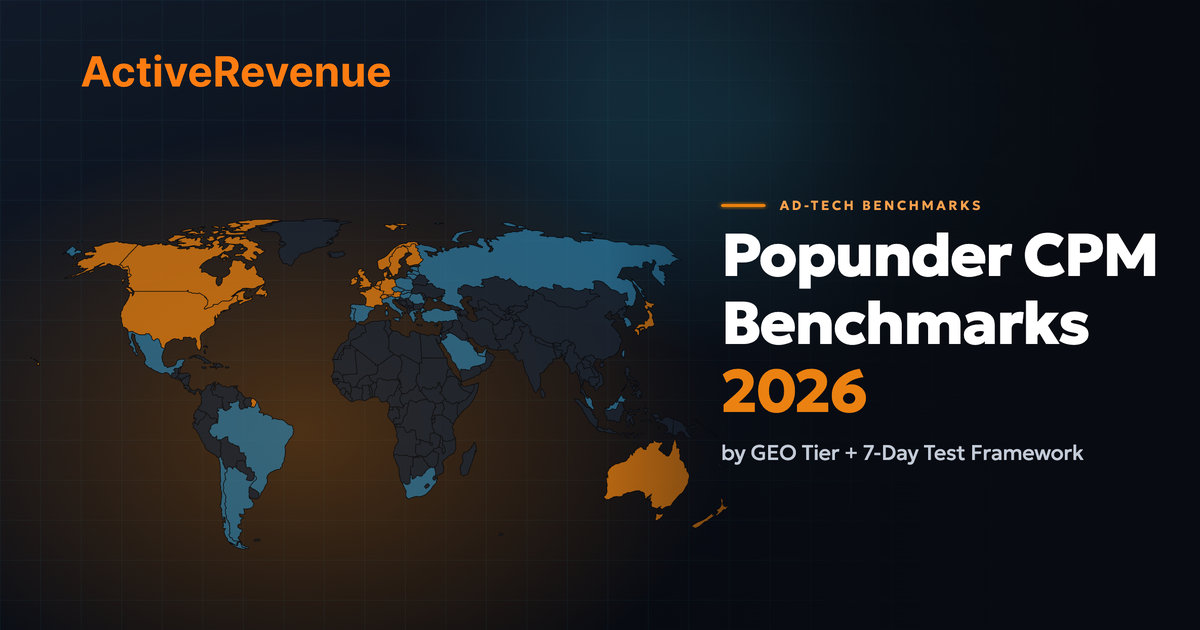
Tier 1 (US, UK, CA, AU, DE): mainstream inventory clears roughly $0.50–$3.00 CPM at the low end, with filtered, fresh desktop inventory reaching $3.00–$6.00+. Competitive verticals push higher — Tier-1 iGaming popunder regularly clears $5–$12 CPM.
Tier 2 (BR, MX, PL, TH, ZA and similar): typically $0.20–$0.80 CPM for mainstream, $1.00–$4.50 where vertical demand is hot — iGaming around major sporting events, finance.
Tier 3 (IN, BD, PK, NG, ID and similar): $0.01–$0.15 mainstream floor, up to $0.50 with strict quality filters. Volume is enormous; the game is filtering, not bidding.
Treat every range as a clearing range, not a rate card. Floors tell you where traffic starts; benchmarks tell you where filtered traffic actually clears.
Why two quotes for the same GEO differ 5x
Before comparing any two CPM numbers, lock these five variables:
- Reporting basis — some platforms show your bid ceiling, others show the auction-clearing price. The gap runs 15–40% depending on GEO.
- Device split — mobile and desktop clear at different levels; a blended quote hides the mix.
- Quality filters — unfiltered feeds with bot and proxy traffic are cheap for a reason. Ask what IVT filtering is applied pre-bid.
- Source type — direct publisher inventory vs. resold RTB feeds behave differently even at identical prices.
- Freshness window — first impressions on a new user cost more and convert more than the tenth impression that day.
If a quote looks too cheap for its tier, one of these five is doing the hiding.
The 7-day test framework
Day 1–2: Setup and floor discovery. One GEO, one vertical, one offer. Split desktop/mobile into separate campaigns. Bid 20–30% above the platform's stated minimum — sitting on the floor buys leftover inventory. Frequency cap at 1/24h. Postback wired before the first dollar spends.
Day 3–4: Placement data. Let each campaign collect at least 2–3x your target CPA in spend before judging anything. Don't touch bids. Build your blacklist only from placements with statistically meaningful spend — killing a source after 50 impressions is noise, not optimization.
Day 5–6: Cut and rebid. Blacklist bottom placements, raise bids 10–15% on converting sources to win more of their auction. If mobile and desktop diverge hard (they usually do), kill the loser entirely rather than averaging.
Day 7: Scale decision. A segment earns scaling when CPA is at or under target across two consecutive days and volume is stable. Scale by widening dayparting and adding adjacent GEOs in the same tier — not by doubling bids.
Budget rule of thumb: reserve 10–20x your target CPA per GEO tested. Anything less and you're reading tea leaves.
Where popunder wins in 2026
The format keeps outperforming for offers with simple funnels and instant action: iGaming registration and deposit flows, VPN and utility installs, sweepstakes, dating in Tier 2–3, and browser extensions. One impression equals one full landing-page load — which is why complicated multi-step funnels waste it and one-click flows print with it.
Start testing
ActiveRevenue's popunder inventory spans 248+ GEOs with granular device, OS, carrier, and dayparting targeting, plus S2S postback support for every major tracker. Run the 7-day framework on your first GEO this week.